✘ Music as the canary in a climate crisisAnd: Inside Bad Bunny's Half Time Show; Micro-licensing in India; History of the Database; Futures of everyday life; Mapping EU live music ownership
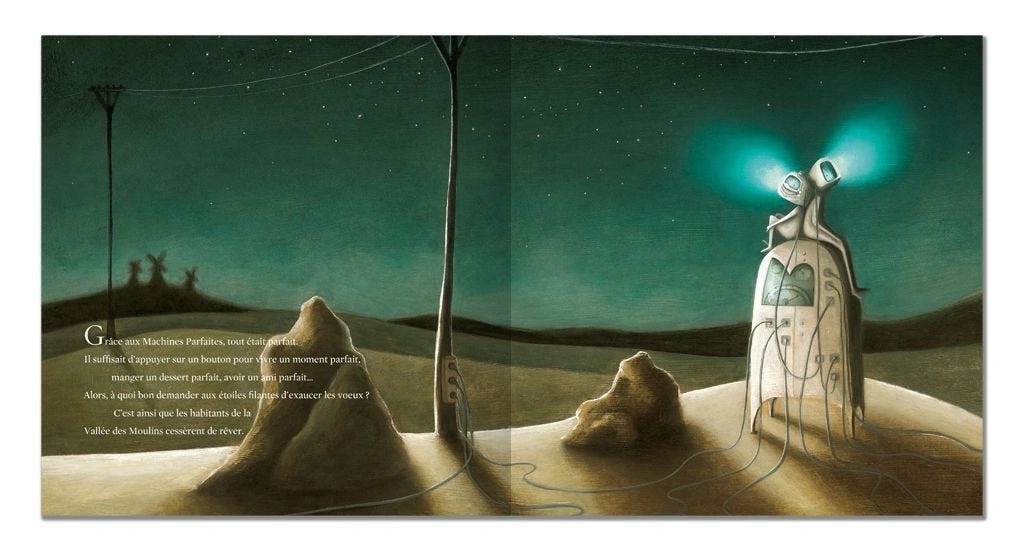
In the wonderful children’s book The Mill Valley, the Perfect Machines arrive that make life perfect, but which take away people’s dreams. This is like many a dystopic idea. The absence of dreams in the book is captured by the absence of wind. From a music perspective we can imagine the absence of birdsong that used to wake us, or the hum of bees in lavender plants, or that low thrum of a gig heard through a venue’s walls from the outside. The dystopia continues as our screens keep scrolling, and everything is not normal. The streaming economy, filterworld, AI - they all force us to understand music as data. Music as content. But music is more than data. Music is material: wood, metal, plastic, sweat, electricity, rubber, glue. It’s a guitar made from spruce that grew in a forest which is now stressed by drought. It’s a vinyl pressing plant waiting six months for PVC that hasn’t arrived. And, it’s a tour bus that got rerouted because a road burned. Slowly, quietly, music’s materiality is changing.
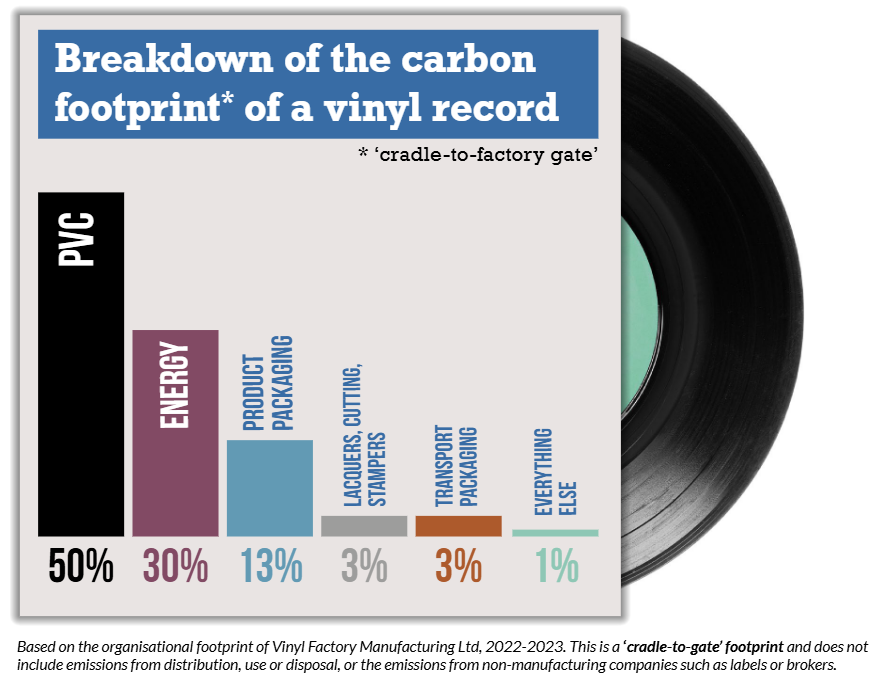
Scarcity is realMusic has been a key element in our world of infinite supply. Click —> Stream. Click —> Download. Press —> Ship. This will change. A 2024 report from the Vinyl Record Manufacturer Association found that the average record carries 1.15kg of CO₂ in its making — half of it from PVC, a fossil fuel derivative. And as global climate policy tightens, that material won’t get cheaper or easier to source.
This asks us to think of scarcity based on physical, material limitations instead of marketing ploys or aesthetics. Yet, it also pushes artists and others to look at what’s next. Artists move the dialDanish-based RPM Records released the soundtrack to I Am Greta - the 2020 bio documentary about Greta Thunberg - in the most environmentally sustainable way possible. They changed their entire production process:
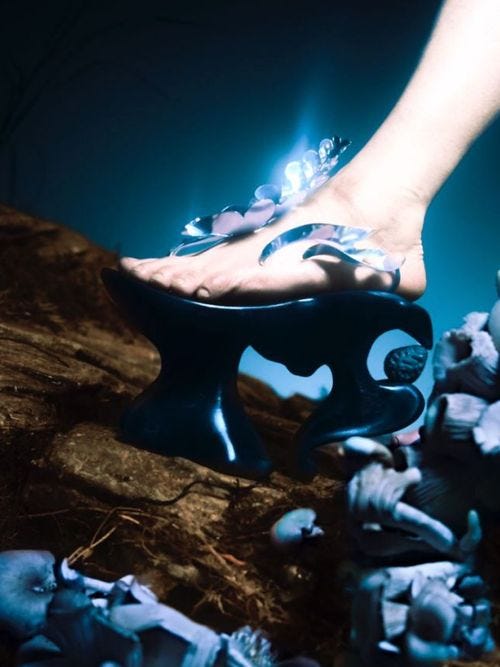
Other examples are the bioplastics records, such as EvoVinyl or Biovinyl. These are made from things like sugarcane and recycled cooking oils. One of the first artists to work with EvoVinyl was Sirintip. She went further than just the more ecofriendly record-pressing solution. The music of the record, called carbon, takes from the climate itself. It was recorded in the carbon-neutral Manifold Recording studio. Moreover, Sirintip used Twotone, the data sonification tool, to take the gradual heating up of the Earth and turn that into her music. If you want to dig deeper into data sonification, definitely check out Portrait XO’s work, too. Taking another angle entirely is Björk, who was pictured wearing Völubein shoes on her 2022 Fossura record. The base of the shoes was made from Icelandic Birch wood and in the heels you see those little eggs: calcified CO2 removed from the atmosphere.
The truly crazy, and very Björk, part about all of this is that she danced around in these shoes for the shoot of that cover. All of these examples show that music is in the studio, sure, but also in the soil and the air, and definitely throughout the entire physical supply chain. Along the way, artists like Sirintip and Björk redefine music itself, how we need to talk about the materiality of music, and even what a music release can mean. Music touching the built environmentOutside of nature, there’s also plenty of experimentation going on that allows us to experience the built environment differently. Music festivals have been trending smaller in recent years, with Stubhub’s 2025 report talking about microfests (which still seem quite large to me defined as sub-60k attendees) as a strong trend going into 2026. These ‘microfests’ attract a more local crowd than the larger ones do. Of course, this report is very US-heavy, so what’s going on in other parts of the world? In the Netherlands, Rewire festival has been stubbornly refusing to grow even though it’s popularity - I feel, at least - keeps growing year-over-year. Crack Magazine last year called their line-ups ‘creatively bananas,’ which is on the money. Beyond the line-up, more relevant to this piece is how these diverse acts perform in historic spaces or repurposed spaces. In doing so, the festival invites its punters to experience the built environment of The Hague beyond the everyday rhythms of life. Another example is Linear festival in Bangalore, which had its first edition last September. The festival runs along the city’s green metro line. The organisers aimed to make the festival accessible and by doing so rooted it into the city’s infrastructure. They took this idea of roots further with their programming focusing on artists from non-urban centres across India and hosting an all-night shadow puppetry performance - a traditional form not usually found in urban centres. Both of these examples lean heavily into niche-curation practices. A palace becomes a resonant chamber and a metro line becomes an urban cultural spine. More than that, both festivals ask questions about proximity. Can we relearn what it means to stay local? Can we move less? What if music, or art more generally, shaped the places it lives in? Music as the sensorWe like to think of the canary singing a warning signal. But perhaps it’s actually showing us the way. All of the stories and examples in this piece are about adaptation. Let’s call it resilience through rootedness. This is a quiet return to the local, the tangible, and the enduring. If music is a sensor for cultural change, what we see here is that music, right now, senses planetary change. Artists are responding with care. Care for materials and for places. Most of all, they respond with care for traditions that actually never needed to scale. LINKS💗 Inside Bad Bunny’s historic Super Bowl Halftime Show (Angela Watercutter)“As viewers saw at halftime, Bad Bunny, who performed in an all-white outfit with a number and “Ocasio” on the back like a football jersey, did get to dance around the set he wanted—the casita, the vintage truck, the wedding stage—but the plants were alive in a way he might not have imagined. Some 380 people donned costumes to make them look like tall stalks of grasses. The stationary palm trees and poles, if you’re wondering, were rolled out much in the same way the streetlights were placed for Lamar’s street scene from Super Bowl LIX. On Sunday, they hit their limit of 25 carts, equipped with so-called “turf tires,” and got everything safely on and off the field.” ✘ I love these yearly insights from Wired about how the people behind the scenes actually put on the Super Bowl Half Time Show. It’s quite a feat! 🐁 Why micro-sync licensing is becoming India’s digital music backbone (Gaurav Dagaonkar)“Yet while demand for music has accelerated, access to music that is both legally compliant and commercially viable has not kept pace. For creators, brands, and advertisers operating at digital speed, the gap between demand and rights-ready supply has become one of the most persistent structural challenges in India’s content economy.” ✘ I’ll keep saying it: let’s look at India for the future of the music industry. Due to the sheer size of the country, the specific nature of it’s economic markets, and a youthful music industry (outside of Bollywood) there’s a need and demand for different monetization models than we’re used to in western territories. 🗄️ History of the Database (Miriam Posner)✘ This is the reading list for a class taught by Miriam at UCLA and it looks awesome. It’s full of great resources so definitely one to bookmark. It also reminded me of this piece by Bas from 2023: Databases as worlds.
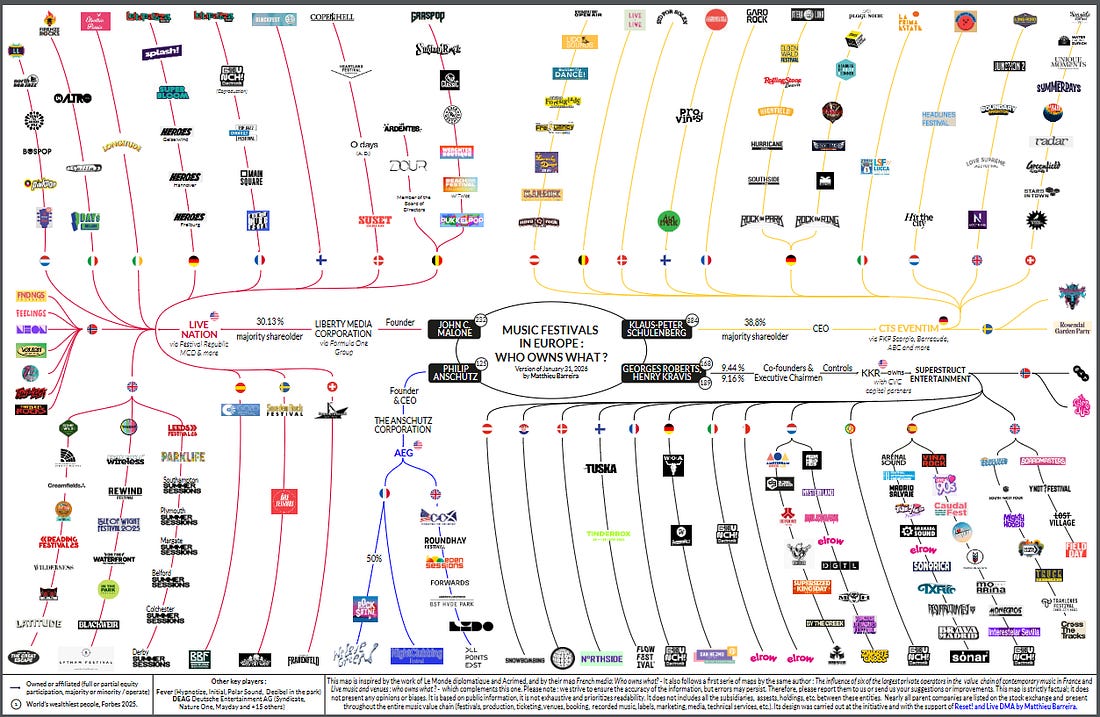
🔮 Futures of everyday life: A qualitative content analysis of future personas in scenarios (Laura Bechtold et al)“The results of these interpretative acts often appear elitist, stereotypical, and technocratic, often replicating dominant societal narratives rather than fostering substantive shifts in how the future is imagined. We therefore call for a more polyphonic representation of futures in scenario writing and foresight work that can produce more discontinuous and transformative images of the future.” ✘ This is very academic, but the shift here is important. I’ve written before about the need to imagine different futures and the subsequent necessity to use, for example, different descriptors and metaphors. This research is that work in action. 🪁 Mapping ownership concentration in the European live music sector (Matthieu Barreira)
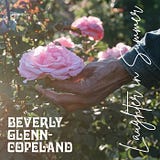
“The European festival ownership map shows that more than 150 of the largest festivals in Europe are linked to just four groups: Anschutz Entertainment Group (AEG), Live Nation, CTS Eventim, and Superstruct.” ✘ We all know this, but to see it in a map hits different. There’s also research on live music venues ownership. This is very important work and I, for one, am glad Reset! and Live DMA have run this research. Now you know what to reference when you talk about the ownership issue in live music. MUSICMusic can do things to us, emotionally. Music converys stories, deeply personal ones at that. Some music does this more than others. The new record by Beverly Glenn-Copeland, Laughter in Summer, is a beautiful contemplation on the love between Glenn and Elizabeth. It’s the kind of love we all deserve. I had a good cry listening to this the first, I hope you allow yourself one, too.
MUSIC x is free today. But if you enjoyed this post, you can tell MUSIC x that their writing is valuable by pledging a future subscription. You won't be charged unless they enable payments.
|