Party ya broker? Pakistan’s Trump affair hangs by a movie dialogueAs Trump pushes Pakistan towards the Abraham Accords, Islamabad’s long-running balancing act between Washington, Tehran and its own anti-Israel identity faces its toughest test yet.
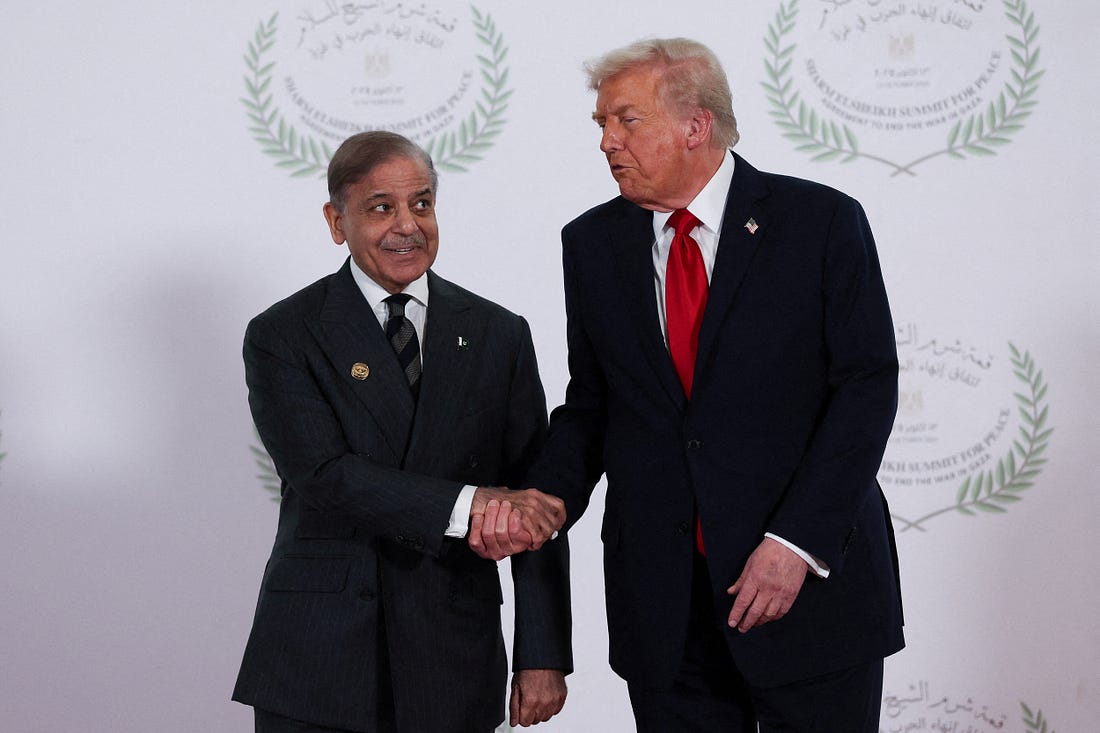
For months, Pakistan has been doing something few countries in the world have managed during Trumpian times — keeping a foot in multiple camps, yet keeping ‘The Donald’ pleased. It’s been using a straightforward method. Shovel daily heaps of praises at US President Donald Trump plus some business with his friends and family. This has meant Pakistan condemned the US-Israeli strikes on Iran, yet kept talking to Washington. It mediated for Tehran, but stayed in Trump’s good books. It helped broker a temporary truce, and got lavish praise for it. Trump called Pakistan Army chief Asim Munir “my favourite Field Marshal” and Prime Minister Shehbaz Sharif got the adjective “incredible”. It further helped that Trump’s businessman friend Steve Witkoff — whose son Zachary flew into Islamabad to collect a crypto opportunity for the Trump family’s venture just weeks before the war began — was one of America’s negotiators, alongside Presidential son-in-law Jared Kushner. Yet, it was a matter of time before Pakistan faced a paradox, typical in how the realtor, TV star and politician Trump does his deals. That brings to mind a line from ‘Khosla Ka Ghosla’, the 2006 Bollywood cult classic about a real estate fraud: “Aap broker hain ya party?” — are you a middleman, or one of the ones making the deal? Pakistan thought it had the answer figured out; it was only a broker. (In the Indian foreign minister’s words, a “dalaal”, a Hindi/Urdu noun used rather pejoratively for a smart alec broker.) Then came a new Monday. Trump set a condition that he repeated through the week. In a Truth Social post, the US President declared it “mandatory” that Saudi Arabia, Qatar, Pakistan, Turkey, Egypt and Jordan formally sign onto the Abraham Accords — the US-brokered normalisation pacts with Israel — as part of any final Iran peace deal. The broker now had to figure out how the deal would land at his own home.
The problem is the historyPakistan has never recognised Israel. Not once in the 78 years since it emerged as a nation after the Partition of India by the British. The rigid position goes back to the Islamic nation’s founder Muhammad Ali Jinnah. He rejected the 1947-48 UN partition of Palestine that formed Israel, a home for the Jews in a land they claim religiously ordained to them; a land populated mostly by Arab and other Muslims for recent centuries at least. In October 1947, just two months after Pakistan came into existence, Jinnah called any recognition for Israel “constitutionally wrong and morally unjust”. He even wrote to the then US President Harry Truman: “The very people for whose benefit this decision [of creating Israel by partitioning Palestine] is taken — the Jews, who have already suffered terribly from Nazi persecution — will… suffer most if this unjust course is pursued. Moreover the decision presents a great danger to world peace.” A year before Partition too, Jinnah told the New York Times he would go to “any lengths” to help the Palestinians — “violence, if necessary”. When Israel’s first PM David Ben Gurion sent him a telegram requesting that Pakistan establish diplomatic relations, the lawyer-politician Jinnah never replied. Trump is now asking, in effect, that Islamabad must write back. Every Pakistani government since 1947 — somewhat democratic, outright military, or hybrid like the Munir-Sharif arrangement — has held the anti-Israel line, certainly in public. This position, along with the religious connotation of it, is baked into Pakistan’s national identity. Shehbaz Sharif went as far as to call Israel’s PM Benjamin Netanyahu “the new Adolf Hitler” during Israel’s 2021 military attacks in the occupied Palestinian territories such as Gaza. Turkey’s Erdogan used the same comparison more recently. That comparison lands violently among many Jews. The Holocaust by Hitler’s Nazi Party in the 1940s is widely seen as a foundational factor in Israel being formed. The religious demand for Israel’s “right to exist” has an even longer history.
The problem is also the presentFor Pakistan, the history of the last few months has been enough of a paradox. Just weeks before the US and Israel attacked Iran, Pakistan joined Trump’s Board of Peace that led to Israel halting its latest attacks on Gaza, after over 60,000 Palestinians were reportedly killed. The Pakistan Foreign Office clarified that the sign-up to Trump’s alt-UN had nothing to do with the Abraham Accords: “There is no change in our stated policy.” Pakistan, in such a situation, is not just another country on Trump’s list of Muslim nations that he wants as signatories to the Abraham Accords. Refusing Trump’s demand could outright freeze Pakistan out of the final settlement. Agreeing to it, or even appearing to, could become a domestic political firestorm. Plus, a rupture with neighbour Iran. Islamabad could, of course, look towards the Royal House of Saud, with which it has a landmark defence agreement and deep political ties. If Mohammed bin Salman of Saudi Arabia blinks, the calculus shifts for the Munir-Sharif regime in Pakistan too. But, remember, we are talking about Trump here. US President’s many wordsThere can be an off-ramp seen within Trump’s original post. He wrote that “one or two countries” might decide not to join the Accords that he brokered in 2020; and that would be “acceptable”. On the Israel question, in fact, Trump has faced some heat at home too, for allegedly having played into Netanyahu’s game and been “blackmailed” into the conflict with Iran. Pakistani journalist-analyst Kamran Yusuf tried to interpret what Trump meant in his Truths on Israel and the Accords. Yusuf said he may have been thinking of Pakistan when he built in an exemption for “one or two countries”. A more instructive observation was made by Michael Kugelman, South Asia expert at US-based think tank Atlantic Council, that Pakistani officials have had informal contacts with Israel in the past, even if publicly the two-state position has been held. The India contrastNew Delhi’s role here is also instructive, not just as a neighbour watching but as a contrast. India, which has a Hindu majority and one of the world’s largest Muslim populations, has managed a national position aligned with its statedly secular system. It spent years carefully de-hyphenating its Israel and Palestine positions, deepening defence and tech ties with Tel Aviv while also supporting a two-state solution. This has been described as studied ambiguity, somewhat adjacent to Nehruvian-era India’s non-alignment — or, in India’s more recent lexicon, strategic autonomy. PM Narendra Modi has deepened ties with Israel in recent years, even at the cost of criticism domestically, such as for his visit to Israel just before the attacks were launched on Tehran. To be sure, the Islamic Republic of Iran, an avowed anti-Israel regime, has had no issues still counting Delhi among friendly countries. That was evident in India-bound ships being given passage through the Strait of Hormuz. That shows, tilt or no tilt, the architecture of de-hyphenation has held for India. Pakistan does not have that architecture. And it can afford no tilt, certainly none that looks like India’s or Modi’s. Where that leaves PakistanA deal may be done by the time you read this. And the Abraham Accords question would probably be set aside for now. But it is, now, out of the bottle. Pakistan has navigated this ambiguous space for decades. Whether it can do so while the region is this volatile, and the man on the other end of the phone is this unpredictable, is the question now. In the comedy-crime thriller ‘Khosla Ka Ghosla’, when Naveen Nischal’s character asks, “are you a party or broker”, he is only pretending to be a rich man with a large real estate portfolio and a larger ego. Trump is for real. Thanks for reading! Subscribe for free to receive new posts and support my work.
|